Left of boom
Sense, cue and act before contact
- Asks “How is this place changing?”
- Flags threats it has never seen
- Expeditionary: no runway, minimal crew
- Attritable, affordable mass; zero emissions
- Cues the kill web before visual emergence

Level 42 AI · DIU Low-Cost ISR (LC-ISR) Challenge
We fingerprint how a place behaves and flag the instant it changes. Left of boom.
The problem
Legacy ISR is a contour map plus a signature library: it knows where things are and what it has already seen. Like early genome annotation, it recognizes only what its frameworks were built to see — not what has changed or is changing.
Sense, cue and act before contact
React after the visual. Too late.
Urgency: every day without affordable passive sensing is another day adversaries move inside the gaps between expensive ISR looks.
Core insight
Threats adapt signatures. Physics still disturbs pressure, vibration, electric potential and timing.

Traffic, wind, HVAC, surf, rotor wash, engine vibration and human activity form a background pattern with stable local structure.
Anything with mass, motion, frequency, wavelength or electric-field contrast perturbs that pattern.
Group-symmetry, topology and sequence models turn disturbance geometry into bearing, localization, class and activity state.
The paradigm: V!broKinetic Topology Fingerprinting
Level 42 AI’s Anthropophony™ platform turns ambient battlefield disturbance into early cueing, custody and downstream action.

Like a platypus in muddy water or a tiger beetle sprinting blind, we sense by vibration, pressure and timing, spending a small data budget only on change.
Contour maps show where things are: position, elevation, slope. We fingerprint how a place behaves: topology, frequency and vibration over time.
Anything with mass and motion breaks the ambient symmetry in pressure, vibration and electric potential. The break is actionable.
No signature library. No emission. Even threats never cataloged, never seen before, cannot hide from physics.
Spectrum, beyond light
Drag across the scale. The shaded band is what human ears can hear; the rest is where the payload keeps listening.
Sensor stack
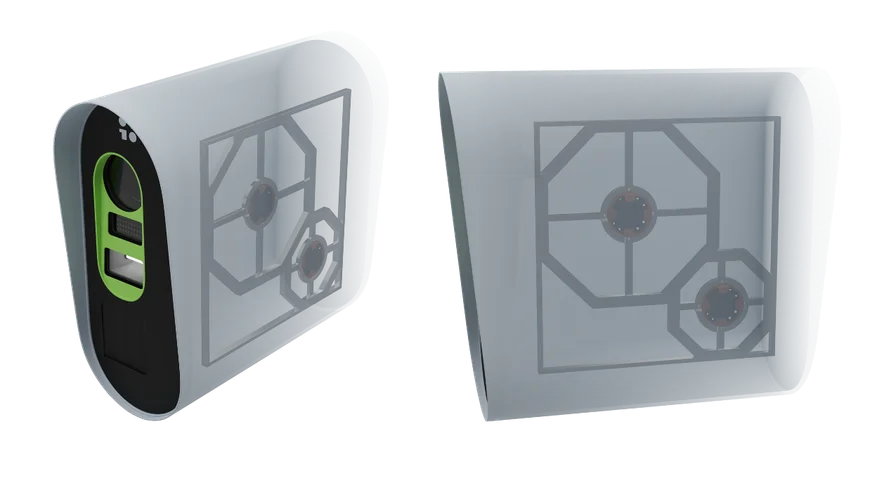
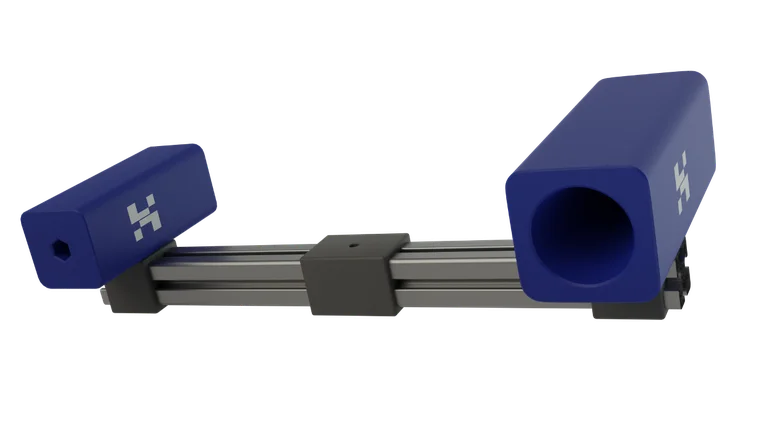
Level 42 AI integrates vibroacoustic sensing, electric-potential sensing, bowtie aperture geometry and edge AI.

Design principle: cheap enough to proliferate, quiet enough to survive, open enough to integrate.
The asset
A carrier-agnostic passive ISR payload for the transparent battlefield.
Acute infectious disease
Chronic non-communicable disease
Maternal–fetal development and degenerative disease
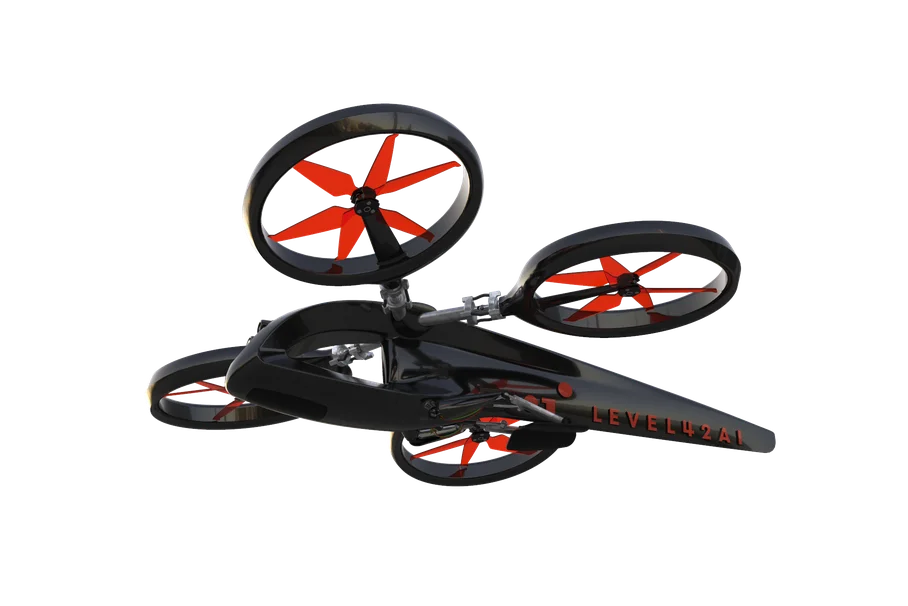
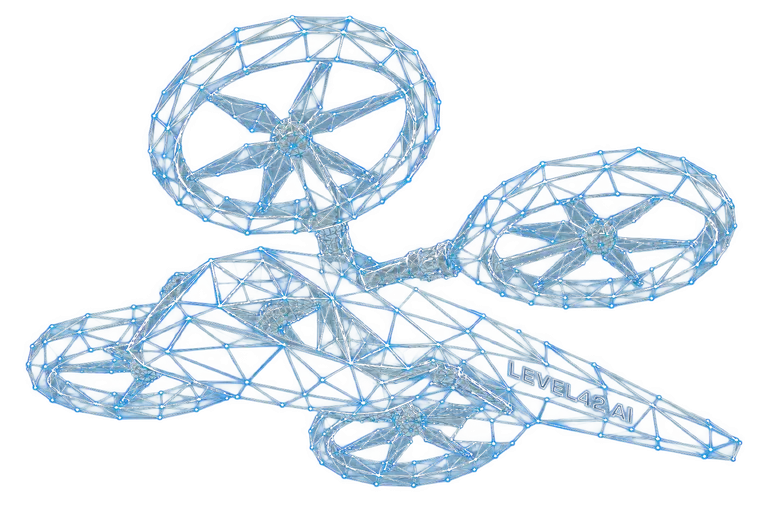
The aerial platform: L42 ISR drone
Medium (3–12+ h) and long (12–24+ h) profiles from one modular power system
Planned, offloaded and launched by a minimal crew
Operates through dust, water and shock
Austere launch, recovery, refuel and refit
The payload: multiphasic sensor stack
Vibroacoustic: infrasonic, audible sound to ultrasonic environmental signatures
Electric: passive E-field disturbance, no emission
RF: broadband anomaly detection
SWaP-optimized: multi-int, decision-quality data within the size, weight and power budget of inexpensive airframes.
Low-power passive stack holds persistent stare
Neurosymbolic AI confirms the symmetry break and bearing
EO/IR, SAR or SIGINT wake only now; hand-off to shooters
The neurosymbolic AI engine: Anthropophony platform
Classify
Persistent homology
Classify scene type and target class
DemonstratedConfirm
Vibroacoustic pressure × electric cross-terms
Correlated activity confirmation
DemonstratedAnticipate
Operator theory
Track activity sequences, anticipate state
In developmentPre-cue
Phase-space transitions
Pre-event cueing
DemonstratedLocate
Peter-Weyl decomposition
Immediate passive bearing and localization
DemonstratedThe V!BEC2 interface

Hearthe inaudible
Feelthe imperceptible
Seethe invisible
Contested, DDIL & the transparent battlefield
On a transparent battlefield, if you emit, you die. We classify and take bearing from disturbance alone. We never emit.
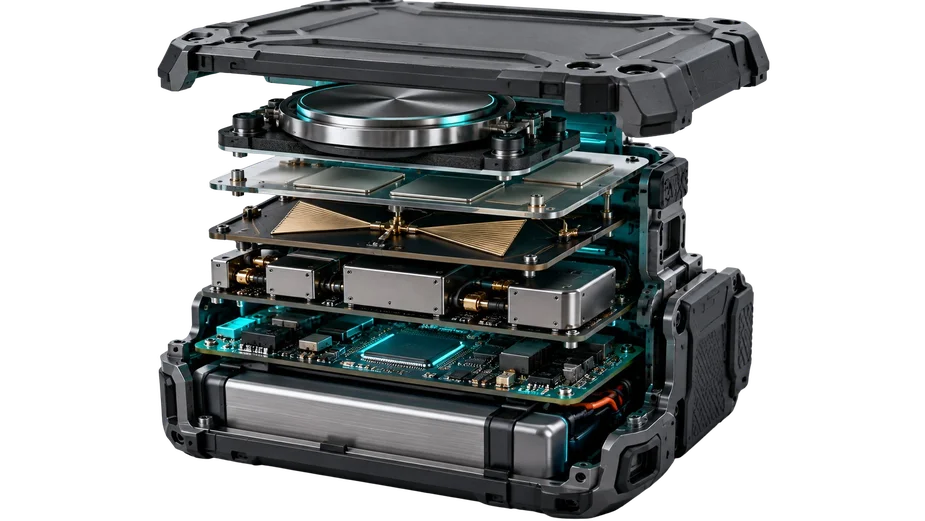
Detection, classification and bearing with zero RF or radar emissions: no signature for the adversary to hunt.
Orientation and terrain sensing from the local mathematical topology of the ambient field, with no satellite dependency.
Sensor data over Government-directed radios and waveforms, LOS and BLOS, via our C2 integration TDP (interface docs + SDK/API).
Universal domain execution
Vehicles sensed on entry
Downrange surface contacts flagged
Submerged contacts pinpointed
Autonomy & Modular Open Systems Approach
Vibroacoustic · E-field · RF + third-party EO/IR, SAR
Agentic Neurosymbolic AI: H1–H5 automated detection and alerting
Documented APIs, SDK and C2 integration TDP
Project AVO · Gov & third-party C2/UI · fires · intel
Edge-computed agentic AI runs detection workflows and alerts automatically, cutting cognitive load on tactical operators.
Payload, data, C2 and radio interfaces are open and documented; only H1–H5 model internals are proprietary.
MOSA alignment designed for the Autonomous Vehicle Orchestrator and collaborative autonomy.
Field validation


Capability maturity map
Today
DemonstratedFly-offs · FY27
In integrationBeyond FY27
ProjectedLet’s field left-of-boom ISR together.
Tell us about your program or integration. We reply from info@level42.ai.
Thank you. We’ll be in touch from info@level42.ai.